Most shops already mystery-shop themselves. Someone calls, asks for an oil-change price or a Saturday brake appointment, and you listen to how the advisor handles it.
ChatGPT is doing that job now. A driver types “best independent BMW shop near Oakland” on a Tuesday night. They never call. They never walk in. They take whatever the engine says and book somewhere else — or they show up expecting hours you dropped two years ago.
You cannot sit in the next bay and overhear that conversation. Until now, the only way most owners found out was a confused customer, a wrong review, or silence.
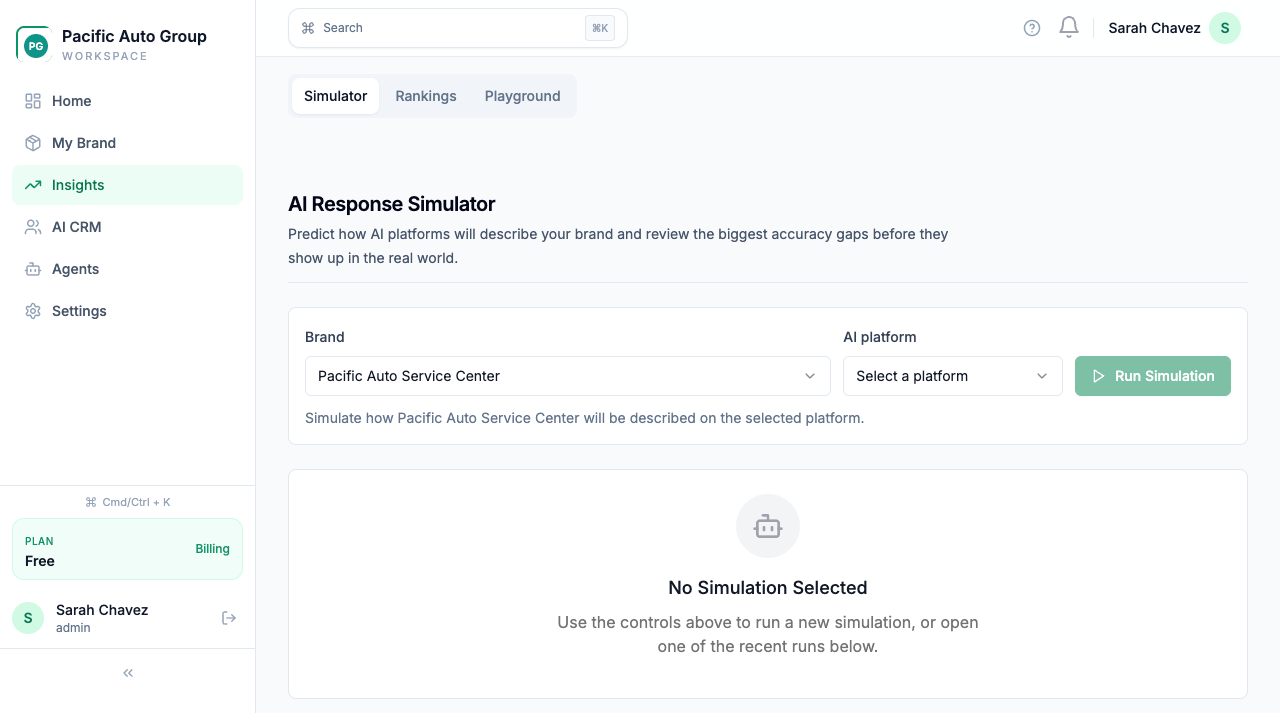
That is what AI Simulator is for. You pick the question. You pick the engine. You read the answer the driver would have gotten.
Why this is not a ranking dashboard
Shop owners keep getting sold “AI visibility” as a score and a trend line. Those are useful later. They do not tell you what was actually said.
The useful artifact is the text:
- Did they mention you at all?
- Were you first, third, or after a dealer that does not even do the work?
- Did they invent a 5pm close when you are open till 7?
- Did they skip the ASE Master Tech and the diesel bay?
- Who did they send the driver to instead?
AI Simulator stores that response, not a paraphrase of it. If ChatGPT named two competitors in your ZIP and left you out, you will see the names.
Two questions the product actually answers
There are two different jobs, and mixing them is how shops get a fake-comfortable score.
Live answers send the query cold. No shop packet stuffed into the prompt. That is the public answer — the one a stranger gets today. This is the mode that surfaces omission, competitor substitution, and hallucination.
Content readiness hands the engine your shop profile first. That is not a prediction of what ChatGPT will say on the open internet. It is the ceiling of what your current content can support. If this run is still wrong, the profile is thin or contradictory. If this run is clean and the live run is not, the facts exist — they are just not what the engine is using yet.
Both runs the pair. The gap between those two is the number worth taking to an owner meeting. A blended score hides it.
A second model scores the answer against your own shop profile as ground truth, so the engine is not grading its own homework. Failed evaluations stay empty rather than getting a polite 50.
Live is what drivers hear. Readiness is what your content could support. The delta is the work.
How a run works
You pick a shop — history stays on that shop, so a second location does not inherit the first one’s runs — then you pick an engine. ChatGPT, Claude, Gemini, Perplexity, and Grok are the five provider APIs we benchmark against. The call is a real model call, not a canned template.
Then you pick the question:
- Brand overview: “What should I know about this shop?” The starting run. Hours, services, certifications, the basics.
- Competitor comparison: how you show up next to the dealer or the other independent down the street.
- Pricing-style: what they say when someone asks what a job costs.
- Custom: paste the prompt a driver would actually type, including ones from the prompt gallery. Make, service, neighborhood.
The run comes back with the response plus:
- Whether you were named, how early, and how often
- Competitor mentions and a simple share of voice
- Sentiment of the write-up
- An accuracy score split four ways: factual accuracy, completeness, clarity, and brand alignment
- The issues the scorer flagged, with severity
- Suggested copy when that is available — current vs. proposed — so the next run has something concrete to test
You change the shop profile. You mark a suggestion done. You run it again. The history is there so you can see whether the answer moved.
Why shops actually use it
Not because they want another dashboard. Because the failure modes are specific:
- The invented fact. Wrong hours, a dropped service, a certification you do not have, a phone number from the old building. Those become Saturday-morning arguments at the counter.
- The silent skip. You do 30 oil changes a day and you do not appear for “oil change near me.” A score of “low visibility” does not tell you that. The missing name in the answer does.
- The dealer substitution. Specialty shops get lumped in with generalists, or skipped for a dealer that is not taking the work. You need the ranking inside the paragraph, not a brand-mention toggle.
- The thin profile vs. the unread profile. Live vs. readiness stops the wrong fix. If readiness is already weak, write better shop facts. If readiness is strong and live is empty, the engine is not citing you yet — that is a different job than rewriting the about page again.
Multi-location groups use it the same way, one store at a time. Franchise reporting is a roll-up. Mystery shopping is local. The Oakland store and the San Jose store should not share a run history.
How this sits next to monitoring
AI Monitoring watches for drift after the fact — hours change, a listing goes stale, an answer flips. That is the detection layer.
AI Simulator is the on-demand mystery shop. You choose the prompt. You choose the engine. You read the verbatim answer before you wait for an alert.
You want both. One asks a question now. The other tells you when the answer changed while you were not looking.
What to do this week
If you have never seen the raw answers, start with a free checkup. It is the fastest way to read what the five provider APIs say about a shop without standing up a workspace.
If the shop is already in SocialCRM, open Insights → AI Simulator, run a live brand-overview query, then run both. Take the two answers into the Monday meeting. Fix the one invented fact that would embarrass you at the counter. Re-run it.
AI Simulator is live in the dashboard. The public walkthrough is on the product page. A free checkup will show you the first answers if you have not looked yet.